Overview and Rankings

A Deep Dive Into Graphic Design

Combining academic knowledge with practical experience to prepare graduates for a wide range of graphic design careers.

The BA (Hons) Graphic Design is built around producing designers who are curious, empathetic, responsible and technically adaptable — equipped not just to make things look good, but to shape how people understand and respond to the world around them.

The course exposes students to a wide range of design contexts and outputs, from branding and advertising to information design, giving a holistic foundation whether a student ends up a generalist or a specialist.

Teaching is structured around four threads of inquiry — Narrative & Time, Systems & Information, Strategy & Direction, and Personal Development Planning — underpinned by the course’s key pillars of experimentation, community, vocation and critical thinking.

  • Top 10 Universities Ranking
  • Top 11 Universities Ranking

Study Themes

What You'll Learn

You will master the following topics during your study at this programme journey.

Our successful graduates will be confident, socially engaged designers who can demonstrate a range of individual, collaborative and professional skills and attributes.

Graphic Design students develop expertise across visual strategy, design contexts, visual communication and design practice, learning to research, conceptualise and execute work across print, digital, moving image and interactive formats.

Graduates will exhibit strong critical thinking and cultural awareness, the adaptability to work across continuously changing professional and cultural contexts, and the technical and creative confidence to define their own personal design identity within the industry.


  • Visual Strategy

    Utilize a research-based, human-centric approach to create & direct visual content – be it type, image, color, moving elements or copy – to best communicate messages to different audiences in order to effectively drive interest and action.
  • Visual Communication

    Explore digital and analogue image-making, including drawing and printmaking, alongside contemporary approaches utilizing photo-manipulation and vector graphics, amongst others.
  • Design Contexts

    Investigate professional applications of graphic design in areas such as branding, advertising and information design, and look at the subject’s theory and history across international contexts.
  • Design Practice

    Integrate graphic communications across multiple formats and channels – including print, moving image, digital and interactive – to create coherent campaigns and brand identities.
Brand Identity Designer
Art Director
Editorial & Publication Designer
UI & Digital Designer
Motion Graphics Designer
Advertising & Campaign Designer
Packaging Designer
Concept Artist

Career Paths

Where This Degree Takes You

Explore the opportunities and possibilities that can follow your degree.

Graphic Design graduates leave equipped to work across the full spectrum of visual communication, from brand-building to storytelling to problem-solving through design — positioned for both generalist design careers and more specialised trajectories in postgraduate study or industry, supported by live client briefs, national and international competition experience, and an international course network spanning Egypt, Singapore and Hong Kong.

Journey

Your Academic Journey

What do you want to learn to achieve the career paths mentioned

  1. 1 Art, Design and Media 1: Exploration
  2. 2 Art, Design and Media 2: Transition
  3. 3 Foundation Academic English 1 for Design and Media
  4. 4 Foundation Academic English 2 for Design and Media

Please Note: We regularly review our course content to make it relevant and current for the benefit of our students. For these reasons, course modules may be updated. Text Link

Credits/National Hours
  • What is credit/national hour?

    A credit/notional hour is the formal name for the estimated hours that are expected that a student would need to complete a module

  • How many hours is 1 credit?

    1 credit is equal to 10 notional hours, so 20 credits are equal to 200 notional hours, The 200 hours includes time in lectures, tutorials, preparing for your lectures, assessments as well as your own personal revision and studying that you would do

  • Can study hours exceed the estimate?

    In reality, you might actually go above and beyond the expected notional hours, in particular if your degree requires a lot of independent learning you would most likely exceed the predicted hours

  • How many credits are in a UK semester?

    In the UK system each semester is 60 credits worth which is equivalent to at least 600 hours of study in one term. This is approximately equivalent to 8 hours of study a day

Facilities

Programme Facilities & Beyond.

Check our campus facilities and services. Flip through different categories images to explore.

In our ever-changing world, mechanical engineers develop new and differing uses for technologies and materials, in order to improve the mechanical operation of equipment and devices used in anything from food and oil production to international construction projects or the design of toys.

You will have the opportunity to participate in field trips and internships in major engineering companies locally in Egypt and in international companies.
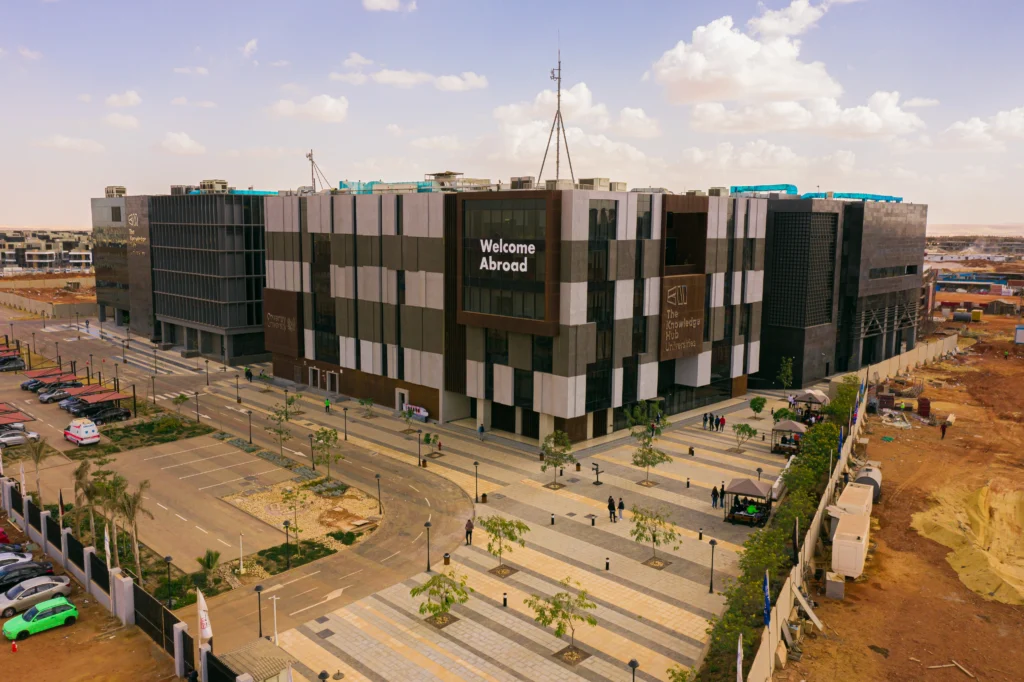
You will have access to modern facilities such as the Manufacturing & Materials Centre, the Civil Engineering & Structures lab, the Hydraulics lab, the Thermofluid lab, the Automation & Control Systems lab, Engineering Lab Building, the Fablab, the Electrical Engineering lab, and the Electronics Engineering lab among many other labs.

Impact

Graduate Success Stories

Roqaia Hazem

Video Editor & VFX Artist, MO4 Network , Part-time Assistant Lecturer, Coventry University at The Knowledge Hub

I chose the Digital Media pathway at TKH for its unique range of curriculum, from game and web development to 3D art and media production. This diversity distinguished me in the market and helped me grow as an interdisciplinary creative. Today, I work as a Video Editor and VFX Artist at MO4 Network, working on major regional events and projects for leading brands.