BSc Information Management
Overview
A Deep Dive into Information Management
“The world’s most valuable resource is no longer oil, but data.” (The Economist 2017)
The Bachelor’s Degree in Information Management combines the best of management with the power of data. It teaches you how to use technology, analysis, and strategic thinking to solve real-world problems in any organization.
Information Management transforms data into knowledge, supporting smarter, faster, and more informed decision-making.
Throughout the course, you’ll develop skills to analyse, structure, and apply information effectively, using modern tools and a future-oriented approach to management.
It’s a practical and up-to-date program, designed for those who want to be at the forefront of digital transformation and data-driven management.
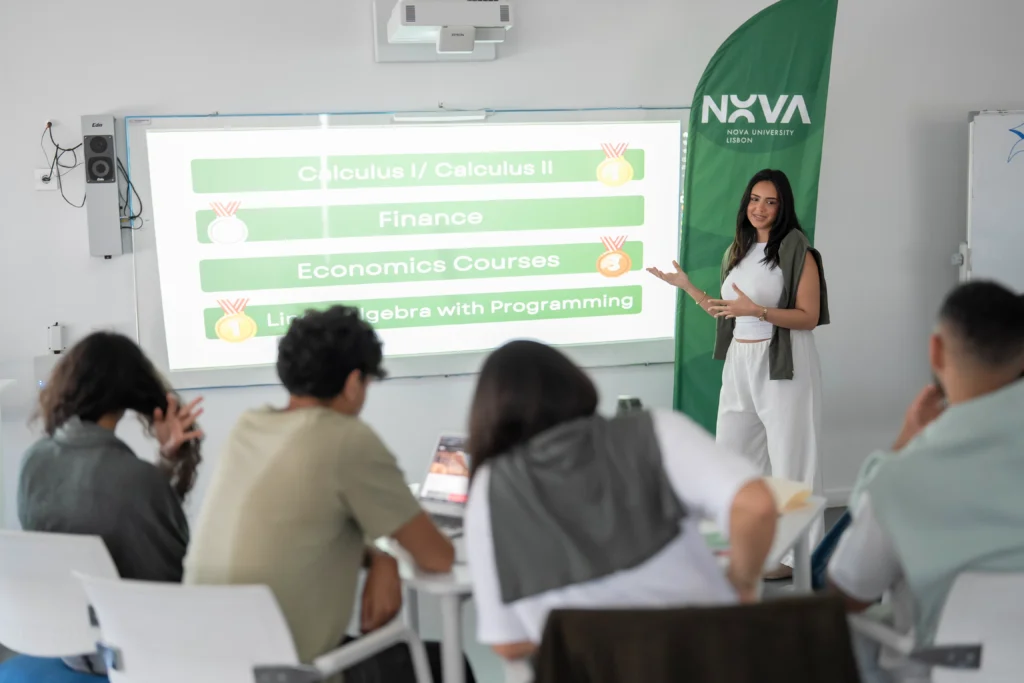
- Business & Technology Combine business knowledge with digital and information skills to support smarter organisational decisions and innovation.
- Data-Driven Decisions Learn to manage and transform information into valuable insights that help organisations improve performance and solve complex challenges.
Study Themes
What You’ll Learn
You will master the following topics during your study at this programme journey.
The Bachelor’s Degree in Information Management prepares students to face the challenges of the digital age by developing skills that meet the new demands of data-driven organisations. In this context, graduates in Information Management should be able to:
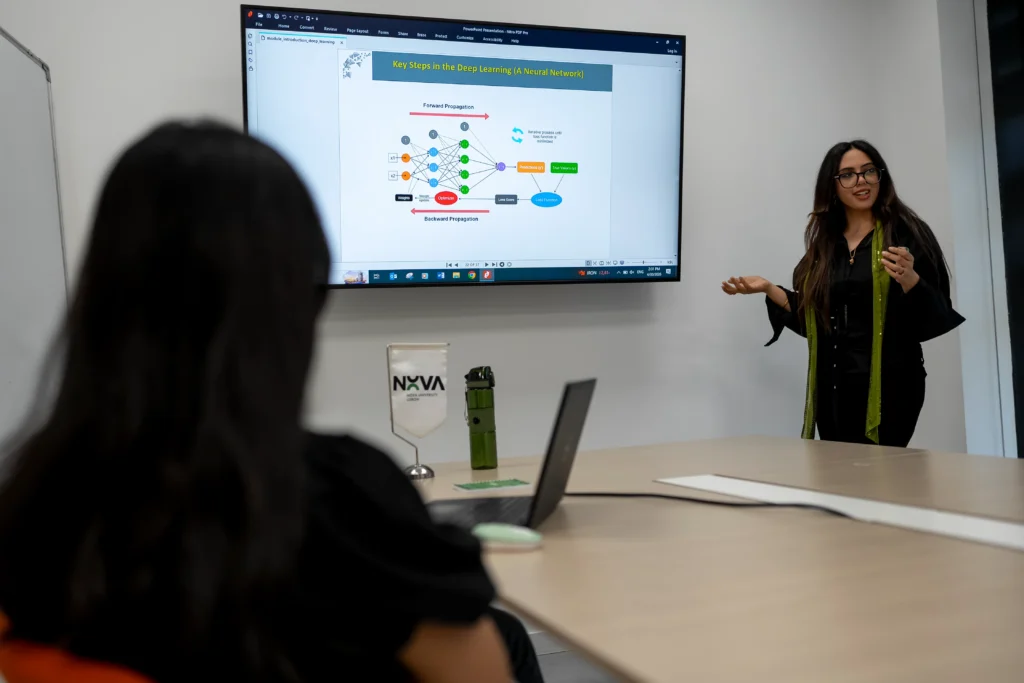
- Master a set of techniques and methodologies for data collection;
- Master the tools and processes used for the storage, organization and access to information in a business context;
- Understand the paradigms and technologies currently used in the management and dissemination of information;
- Master the methodologies as well as statistical and computational tools for exploring and analyzing information in order to reduce the levels of uncertainty associated with decision making;
- Develop models for the establishment of information flow to improve the processes of decision support and business management;
- Be able to identify problems related to the management of information in organizations;
- Know how to transform data into useful and relevant information, using language accessible to various decision centers;
- Be able to develop autonomously, solutions to new problems based on the knowledge gained from the answer to previous problems.
Career Paths
Where This Degree Takes You
Explore the opportunities and possibilities that can follow your degree.
The Bachelor’s Degree in Information Management opens doors to a smooth entry into the job market, with career opportunities in sectors such as technology, banking, insurance, healthcare, telecommunications, logistics, marketing, retail, and consulting.
Journey
Your Academic Journey
What do you want to learn to achieve the career paths mentioned
- 1 Advanced Topics in Mathematics
- 2 Technical English
-
3
The Portuguese
(two modules)
- Portuguese Language
- Portuguese Lifestyle
- 4 Introduction to Project Development
- 1 Linear Algebra
- 2 Economic Analysis
- 3 Business Management
- 4 Computation I
- 5 Mathematical Analysis I
- 6 Information Systems
- 7 Mathematical Analysis II
- 8 Foundational Aspects of Information
- 9 Programming for Business
- 10 Personal Development I
- 11 Marketing
- 12 Statistics and Probability Distributions
- 1 Data Analysis
- 2 Databases I
- 3 Geospatial Intelligence
- 4 Data Preprocessing
- 5 Financial Analysis and Management Control
- 6 Statistical Inference
- 7 Machine Learning
- 8 Business Intelligence
- 9 Econometrics I
- 10 Nonparametric and Computational Statistics
- 11 Survey Methodology
- 12 Computational Methods for Optimisation
- 1 Personal Development II
- 2 Econometrics II
- 3 Market Research
- 4 Business Strategy and Digital Transformation
- 5 Business Process Management
- 6 Enterprise Information Systems
-
7
Final Semester
(Student will choose from the below)
- Financial Calculus and Project Analysis
- Smart and Sustainable Cities
- Mobile Apps Development
- Remote Sensing
- Informatics and Information Law
- Business Law
- Applied Economics
- Entrepreneurship and Project Analysis
- Geospatial Analytics
- Innovation Management
- Project Management
- Risk Management
- People Management and Leadership
- Information Tecnologies, Governance and Service Management
- Web Marketing and E-business
- Forecasting Methods
- Digital Innovation Projects
- Information Systems Seminar
- Technologies and Web Apps
- Web Analytics
Please Note: We regularly review our course content to make it relevant and current for the benefit of our students. For these reasons, course modules may be updated.
Instructors
Meet Our Outstanding Instructors
Stay Updated